
The Right Amount
By Diane Barrett
I could make a lollipop last for hours. At seven, I knew the skill wasn’t in licking or sucking away the juices, but in restraint—letting the orange flavor release itself slowly, drop by drop, lingering on my tongue. Even when I did lick, it felt like an hour of sweetness. I didn’t yet register the irony that our dentist was the one handing out lollipops as a reward for enduring pain in the chair.
My parents were wise, and I knew it—even then. I had older siblings who understood how church worked and were happy to explain it to me. Sunday morning church was a chore of a different kind. Smile, but be quiet. Wear ill-fitting tights and my yellow hand-me-down dress. Sit still, pay attention, fold my hands just so. Say my Our Fathers and Hail Marys at the right time. Sing—or at least open my mouth so it looked like I was singing.
Church felt performative, like I had been cast in a role I didn’t audition for. I can’t say I was ever excited, but when my Nana was visiting, church sometimes came with a promise: breakfast at Bickford’s.
My dad would say it was for breakfast, which was fine enough, but really it was the chocolate shop next door that I craved. While the adults talked, my eyes wandered to the glass case filled with dozens of choices. My dad always let each of us pick one chocolate. I chose the molded objects—a giraffe, an angel, a toy soldier—each with a stick in the middle so you could parade the prize first, use it as a sword with Linda Marie, and only later, slowly and decadently, lick it down to nothing. I always favored the longer, larger ones.
I don’t think I fully understood the word indulgence growing up. It wasn’t that we were deprived; it was that we didn’t seem to have excess of anything. There was enough—measured, accounted for, purposeful. And yet, even then, indulgence was possible.
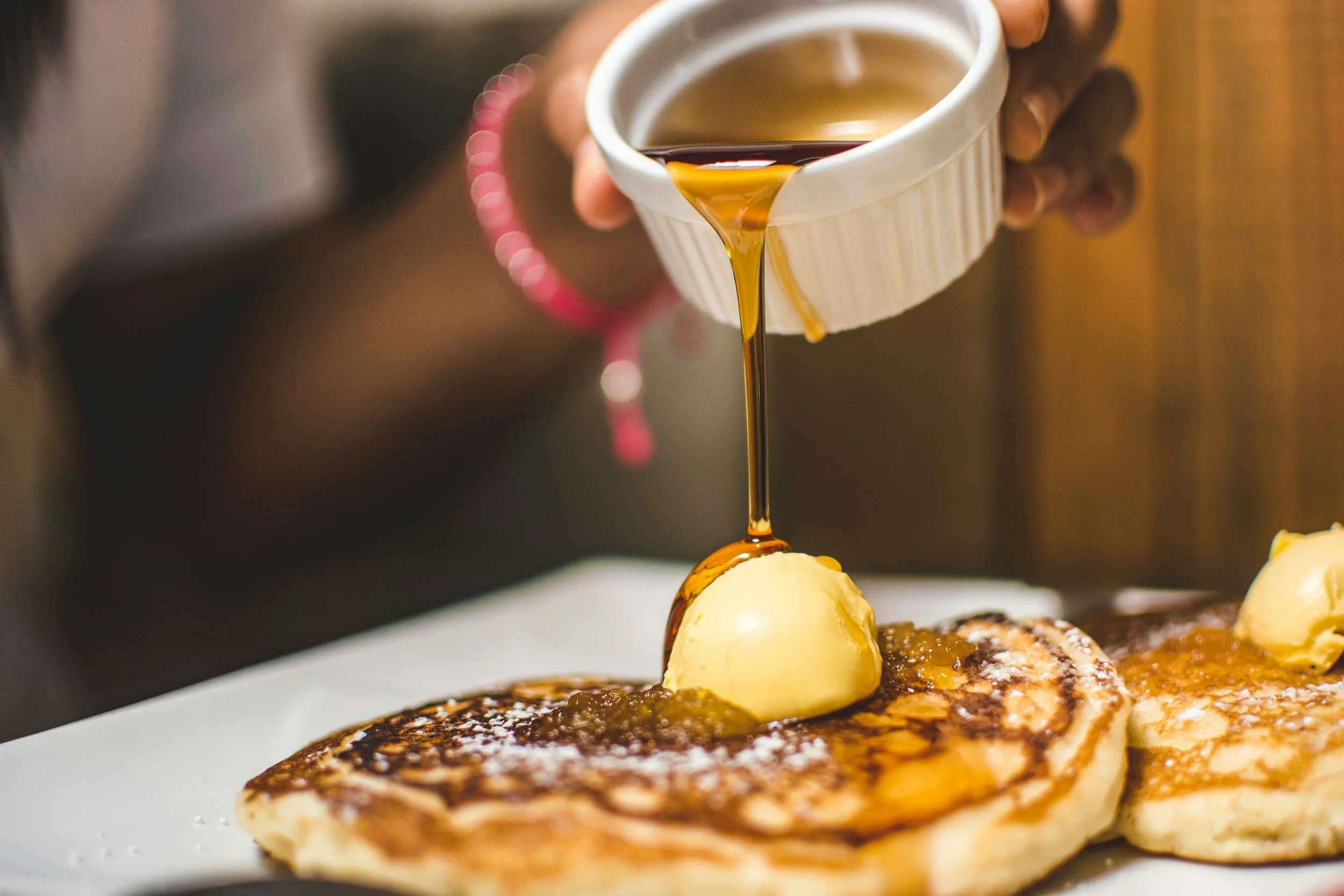
As a child, I wasn’t aware of options. Certain experiences taught me instead—often on rare occasions—what it meant to choose more. Our trips to Bickford’s meant that if I ordered pancakes, the meal came with a tray of six kinds of syrup. I was allowed to pour as much as I wished. I discovered something quickly: beyond a certain point, the pancake disappeared. The waterfall of syrup transformed it into a saturated sponge of maple sweetness. At that point, it was hard to eat. Each time we returned, I delighted in figuring out what was just the right amount for me.
Watching my mom cook daily was her version of a choreographed effort—predictable, requiring attention, coordination, timing. Because nothing was casual, I became aware of what mattered. She protected the use of real butter, milk that wasn’t powdered, cheese, and any baked goods from Aunt Agnes. We weren’t allowed to use them without understanding their value.
The cheese was for Dad. Joey cared about the real milk, so I left that for him, noticing the difference between it and the cloudy version we were given, with its long aftertaste of something unsatisfying. When my mom left for an evening of bingo, Dad would cut up his sharp cheddar and sprinkle it into a bowl of potato chips while watching a game. Although he let me eat some, what I remember most is watching him devour that large bowl so joyfully.
When I was eighteen and sick—newly epileptic, depressed, without an obvious return path to wellness—my parents took my younger brother and me to Disneyland. I don’t remember laughing. I remember feeling flat, disinterested, unreachable. But the act itself has stayed with me. The sacrifice of time, money, and attention. Their belief that something good might still reach me.
What I carry isn’t the park or the rides. It’s the warmth of being chosen. The quiet message beneath it all: you are worth this effort, even when nothing seems to help.
Some indulgences I gave myself instead. Time outside. Staying out late. Risk-taking in high school that felt like a private rebellion against order and expectation. Drinking. Kissing.
One night, in the dark, I kissed the younger brother of my boyfriend—after we had already broken up. We never spoke of it again. The secrecy was part of the indulgence. He had a darker shadow than his older brother, who was a goody-two-shoes. The kiss was amazing. Magnetic. It didn’t fix anything, but it reminded me I was alive.
In my twenties, indulgence took on another form—borrowing courage from people who seemed freer than I was. I remember going out with coworkers. Greg was driving. Diane and I were in the back seat.
“Have you ever lifted your shirt going through a toll booth?” she asked, as if it were a rite of passage.
Laughing while swallowing all my Catholic fears of burning in hell—no, I hadn’t.
Later that night, we went swimming in a pond near Wellesley College. No suits. Everyone stripped down and went in. And so did I. I moved quickly, barely breathing, as if speed itself could shield me. But once I was underwater, something shifted. Beneath the surface, it felt safe to be naked. My body disappeared into the dark softness of it. I could laugh there, held and unobserved. It was only the brief parade in and out of the water that I rushed through.
Now, decades later, I am staying in a casita with a private dipping pool at Rancho La Puerta. I leave my bathing suit folded in the drawer. I slip into the hot water alone. I linger. I savor the quiet luxury of being unhidden.
In a life spent trying to be a good granddaughter, daughter, sister, friend—and for more than thirty years, a mother—I have learned that indulgence is not excess. It is calibration. It is knowing when sweetness appears and allowing myself to receive it fully.
The lack was never the lesson. It was the gift.